2026/04/09 05:53
People are born with the capacity to run.
And running is also an act through which we continue to be reborn.

⸻
To my brothers and sisters around the world,
First, let me properly introduce myself.
My name is Ten Kodaira.
I was born in Tokyo,
on July 7, 1977, at 7 a.m.
I was small and often sick, but I loved moving my body as a child.
However, one incident changed everything.
A footrace at my kindergarten sports day.
It was the first time in my life that I was given a “ranking.”
From that moment on, I came to hate running.
Because the difference in speed made me feel as if even my dignity and worth as a human being were being ranked.
The fast were superior.
The slow were inferior.
I could not find my place within that structure.
Instinctively, I thought:
I must protect my soul.
From then on, I began to distance myself from exams scored by points and sports judged by rankings.
The strong, the fast, the smart—those were the ones who had value.
I could never truly fit into that system.
And yet, I still had to live within that society.
No matter what I did, there was always someone above me.
An endless competition.
Deep inside, I didn’t want to keep pushing so hard.
But I wanted to be recognized. I wanted to be loved.
I wanted to be strong. I wanted to rise.
Within that contradiction, I kept forcing myself forward.
The more I pushed, the more I failed, the more I was hurt.
Injuries accumulated in my body.
Eventually, I reached my limit.
My autonomic nervous system collapsed, and I could no longer stand or walk.
I lost my job. I lost my home.
I completely fell apart.
I became homeless.
⸻
But now, I can say this clearly.
What broke back then was not me.
It was the “false self” I had been forcing myself to become.
No one made me do it.
It was the fear within me.
The impulse.
The belief that “I must be this way.”
That was what drove me.
So what is my true self?
What does it mean to exist without forcing anything?
What is natural?
To find those answers, I let go of everything.
Everything I had built, my social position, my values.
And I moved to Iriomote Island, a remote island at the southernmost edge of Japan.
⸻
The version of me that lived in Tokyo
was separated from nature—an unnatural existence.
Life in Iriomote dismantled all of that.
Electricity, convenience, information—
everything was minimal.
There, you cannot survive unless you adapt to nature.
Over ten years,
the rhythms of life that had been asleep began to return.
My breathing changed.
My perception changed.
The way I used my body changed.
At the same time,
I regained my dignity as a human and my instincts as a living being.
In that process, I had to face something I had long avoided.
Running.

⸻
I made a decision.
I would run again.
Not based on whether I liked it or not,
not based on whether I was good at it or not.
Because running is a function inherently built into living beings.
Not to become faster, not to defeat someone,
but to align myself.
First, I took off my shoes.
Sneakers designed for speed.
A watch that bound me to time.
I let them go.
Then I began running barefoot through the jungle of Iriomote.
There, I encountered a completely different world.
You cannot kick the ground.
You cannot move forward by force.
To avoid crushing new sprouts.
To avoid stepping on insects.
To avoid startling other living beings.
And to avoid injuring myself.
As a result, my way of running changed.
From running with force
to running in harmony with gravity.
When the way you use your body changes, your thinking changes.
What I thought was “myself” began to collapse.
⸻
At one point, I realized:
I had disappeared.
The boundary between myself and nature dissolved,
and everything felt connected as one.
I had been trying to become something.
But in truth, I was nothing.
I was simply part of nature.
By trying to become something other than myself,
I had been making myself unnatural.
In that moment, I understood.
What is destiny?
It is not a special role or mission.
It is simply living in our original human state.

⸻
When I returned to the city, I began to share this with others.
And I became certain of something.
Most people do not hate running itself.
They hate the “feeling” of running.
Shortness of breath.
Heaviness in the body.
The sensation of forcing oneself.
That is why people attach reasons to running.
To lose weight.
For health.
To become stronger.
To prove something.
Running itself becomes a means, not the purpose.
If results come, they feel satisfied.
If not, it becomes suffering.
In other words, movement itself is not the reward.
But the human body is not designed that way.
The human body is designed to enjoy movement itself.
You can see it in children.
They are not chasing results.
They are not measuring records.
They are not trying to prove anything.
They run simply because moving is fun.
That sensation exists in everyone.
It is just buried under years of unnatural movement patterns.
⸻
For me, the turning point in rediscovering that sensation
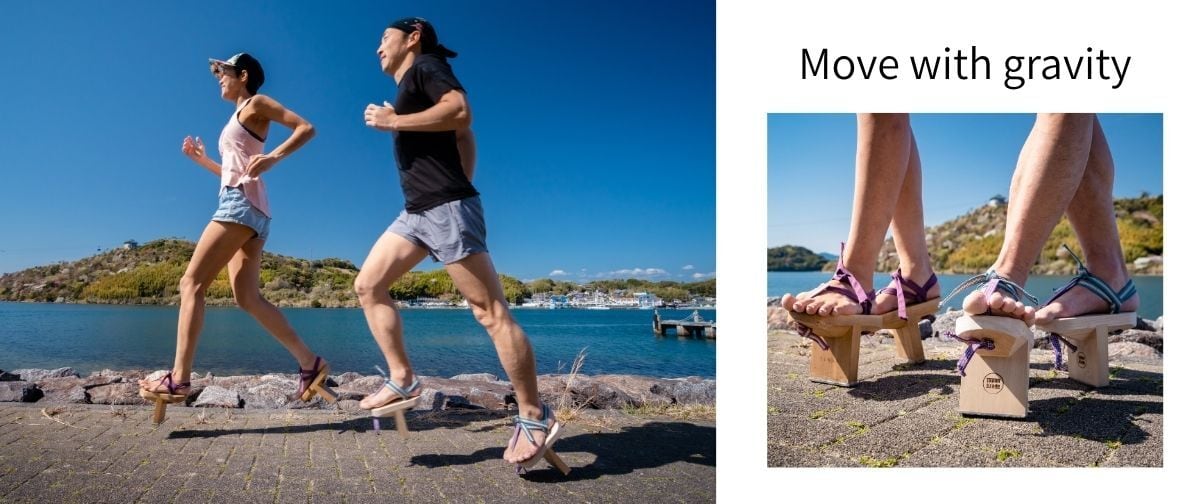
was encountering a traditional Japanese footwear: the single-tooth geta.
Its structure is extremely simple.
A flat platform with a single support point beneath it.
But within that simplicity lies deep meaning.
At first glance, it appears unstable.
But precisely because of that,
the body cannot force stability.
You cannot brace.
You cannot stiffen.
Instead, the body begins to search.
Where is the center of mass?
How can I stand without falling?
And in response to those questions,
the body—not the mind—begins to answer directly.
Excess tension disappears.
An axis rises through the body.
The center of mass begins to move naturally.
It is not something to control,
but something that organizes itself.
In that moment,
a forgotten sensation returns.
Not trying to balance,
but entering a state where balance occurs.
Not controlling,
but allowing the body to organize itself.

⸻
Single-blade wooden sandals have existed in Japan for centuries.
However, they were never designed for running.
They were used for ascetic practice, balance training, and daily movement—not for sport.
When I first encountered this structure, I felt a possibility.
If the body could continue to move while remaining aligned on a single point of support, how far could human movement go—naturally, without force?
To find the answer, I entered a 100km ultramarathon wearing single-blade wooden sandals.
This was not a challenge.
It was a verification.
How far can a body go when it is fully aligned with nature?
I answered that question with my body.
I completed the race.
It was the first recorded achievement of its kind.
But what matters is not the record.
It is the structure.
A body that moves by force cannot last.
A body that moves by balance can continue.
Not speed, but coherence.
That determines everything.
When the center of mass is organized and the axis is aligned, the body continues forward without strain.
There is no need to push. No need to pull.
A subtle shift of the center of mass creates continuous movement.
There is something important to understand here.
Not all single-blade wooden sandals are the same.
Even if they look similar, differences in structure completely change how the body moves.
Performance is determined by design.
– the ratio between the platform and the support point
– the position of the support point
– the structure of the straps
– the materials
These directly affect how the body organizes movement.
The body moves according to structure.
That is why design defines the quality of movement itself.
Through completing a 100km ultramarathon with conventional models, I understood both their potential and their limitations.
Based on that understanding, I redesigned the structure itself.
That is how ippon blade was born.
ippon blade changed the premise.
It made running on a single support point possible, and expanded beyond that into training, daily movement, and refined body awareness.
As a result, new perspectives emerged across running, fitness, yoga, and martial arts.
The design integrates both the Fibonacci ratio and the traditional Japanese Yamato ratio.
By combining universal proportion with culturally rooted body sense, it enables natural continuity of movement without strain.
The craftsman who co-developed ippon blade is also an experienced runner,
and has completed a 100 km ultramarathon using ippon blade.
My wife has also completed a 50 km race wearing ippon blade.
We are a small company run by a husband and wife team.
Over the past seven years, we have sold more than 3,000 pairs.
Across Japan, users are completing marathons and ultramarathons.
Today, people are running half marathons, full marathons, and ultramarathons using ippon blade.
Some have reached distances of up to 200km.
Others have achieved marathon times under 3 hours and 30 minutes.
This is not theory.
This is real performance.
There are many products that may look similar.
But only ippon blade has produced consistent results at the level of marathon performance.
That is the fact.
However, we are not trying to prove superiority, nor do we wish to impose our method on others.
We have learned from cultures around the world, and we understand that each culture has its own methods, values, and paths.
Barefoot is one method.
Shoes are another.
What matters is not what you choose, but how you use it and how you understand it.
We respect all forms of running.
Those who pursue competition, those who seek speed, and those who simply enjoy moving their bodies—all exist on the same plane.
For runners pursuing speed, ippon blade functions as a tool for recovery and form refinement.
At the same time, for those who simply want to enjoy running itself, it offers a new sensation.
And even for those who do not like running, but enjoy moving their bodies, its value is open.
The human body exists between gravity and ground reaction force.
When these two are in balance, an axis emerges.
That axis is the foundation of natural movement.
ippon blade helps you rediscover it.
A single line connecting heaven and earth.
I hope you will experience it in your own way.

⸻
ippon blade is not a reproduction of tradition.
It is a reconstruction of essence.
Nature is not an idea.
Gravity.
Ground reaction force.
Structure.
To align with them.
That is all.
⸻
People are born with the capacity to run.
And running is also an act through which we continue to be reborn.
To my brothers and sisters around the world,
Let’s run together.

To be born again through movement,
you must first return to your axis.
Without alignment,
the body cannot move freely.
RETURN TO YOUR AXIS
Read the full essay: